UNIT: Company F, 23rd New Jersey Volunteer Infantry; Company C, 34th New Jersey Volunteer Infantry
HOMETOWN: Philadelphia; later Tabernacle (then Shamong Township)
BORN/DIED: 1832–1874
RANK: Corporal (23rd); Private (34th)
GRAVE LOCATION: Old Tabernacle Cemetery, Row 8 Lot 1
Approximate Grave Location:
[GRAVE MAP PLACEHOLDER: Gilbert Knight]
Old Tabernacle Cemetery, Row 8 Lot 1
Add an approximate grave-location image when available.

Hear My Story
[AUDIO PLACEHOLDER: Add Gilbert Knight’s audio story and replace the links on the icon and “Hear My Story” heading.]

Read My Story
I am Private Gilbert Knight. I was born in 1832 in Philadelphia. In 1850, I lived in Philadelphia as a blacksmith’s apprentice. I later moved to the village of Tabernacle, NJ. It was part of Shamong Township. I worked as a blacksmith and lived with my wife Hannah and our three children before I entered the Union Army.
I was enrolled in the 23rd New Jersey Volunteer Infantry on August 27, 1862, and was mustered in as a Corporal in Company F on September 13, 1862. I served through the December 1862 and participated in the Fredericksburg Campaign and the May 1863 Chancellorsville Campaign. I was honorably mustered out on June 27, 1863. I was told that the 23rd Regiment, which I had also fought in, lost 4 officers and 31 enlisted men killed or mortally wounded, and 1 officer and 54 enlisted men died from disease.
Over a year later, I re-entered the Union war effort and was mustered in as a recruit Private in Company C of the 34th NJ Volunteer Infantry on September 8, 1864. I served until the conclusion of the conflict and I was honorably discharged at Montgomery, Alabama, on June 6, 1865.
The 34th Infantry Regiment helped with the Union victory in the Battle of Mobile Bay; however, Mobile remained in Confederate hands. We embarked on a land campaign in early 1865 to take Mobile from the Confederates. Our forces then concentrated on Spanish Fort and Fort Blakely, five miles to the north. On March 27, 1865, we rendezvoused with other forces and immediately undertook a siege of Spanish Fort. With Spanish Fort’s fall on April 8 and Gen. Robert E. Lee’s surrender at Appomattox Court House the next day (unrelated to the fall of Spanish Fort, as Lee’s forces were in Virginia), Fort Blakely remained the last organized resistance to the Union east of the Mississippi River. However, as early as April 1, when Spanish Fort’s fall became inevitable, Union forces had begun moving north in order to concentrate on Fort Blakely, which eventually succumbed late on April 9 in the Battle of Fort Blakely. The falls of Spanish Fort and Fort Blakely permitted Union troops to subsequently enter Mobile unopposed after the conclusion of the Civil War, occupying it on April 12, 1865.
The 34th Regiment lost a total of 170 men during service: 3 enlisted men were killed or mortally wounded, and 3 officers and 164 enlisted men died of disease.
The Federal Government paid individual families monthly while the active serviceman was on duty. My family received $11.48 per month. By 1870, my wife Hannah had died, and I remarried Elizabeth. We had one child, which now made me a father of four children. We still lived in Shamong, and I continued to work as a blacksmith. I died in 1874.Today the house I lived in has been preserved by the Tabernacle Historical Society.
My work as a blacksmith was successful. Priore to the war I received $1.61 for smith work, and after the war I was paid $9.89 for work. These were typical amounts my skills helped me earn.
Like most war enrollees, I received a bonus to enlist and clothing allowances. In 1864 my clothing allowance was $41.54 while in my 1863 enlistment I received $37.67. Part of my bonus, $60.00, was sent to my wife Hanah while I was away.
When I died in 1874, my will was probated and all of my personal property was noted. I had two cows and one hog, as well as several chickens. Our book “library” contained six books and I feel we were able to read a lot.
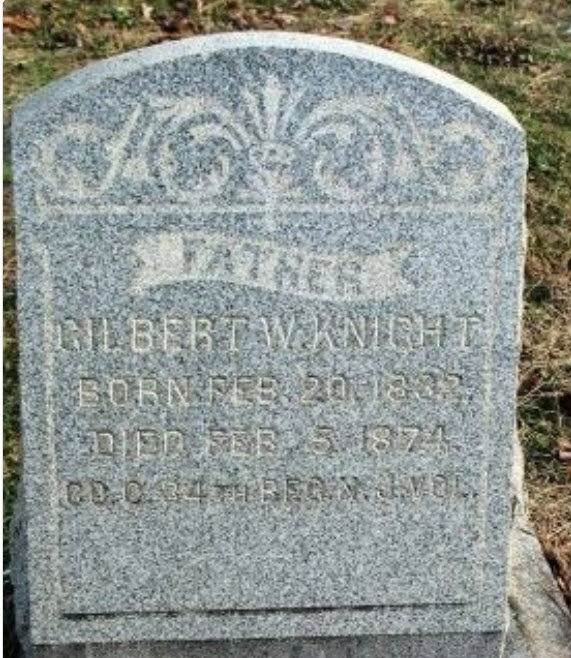
Gilbert Knight (Old Tabernacle Cemetery Row 8 Lot 1)
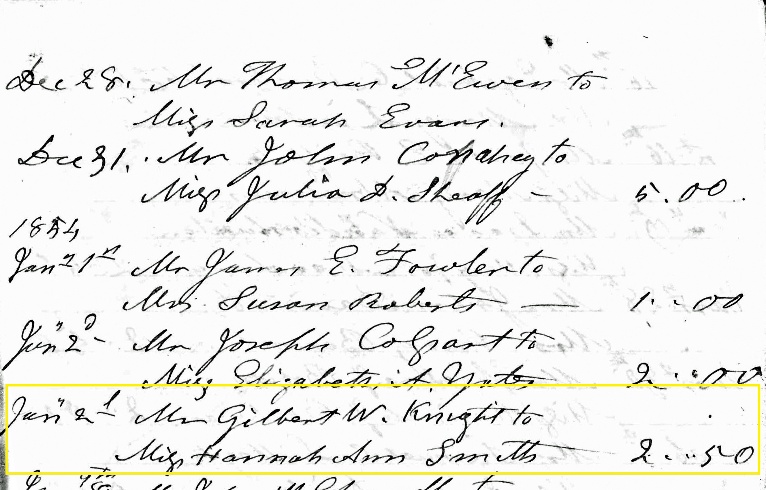
(Gilbert Knight January 2nd, 1854, marriage in Philadelphia to first wife Hannah Smith)
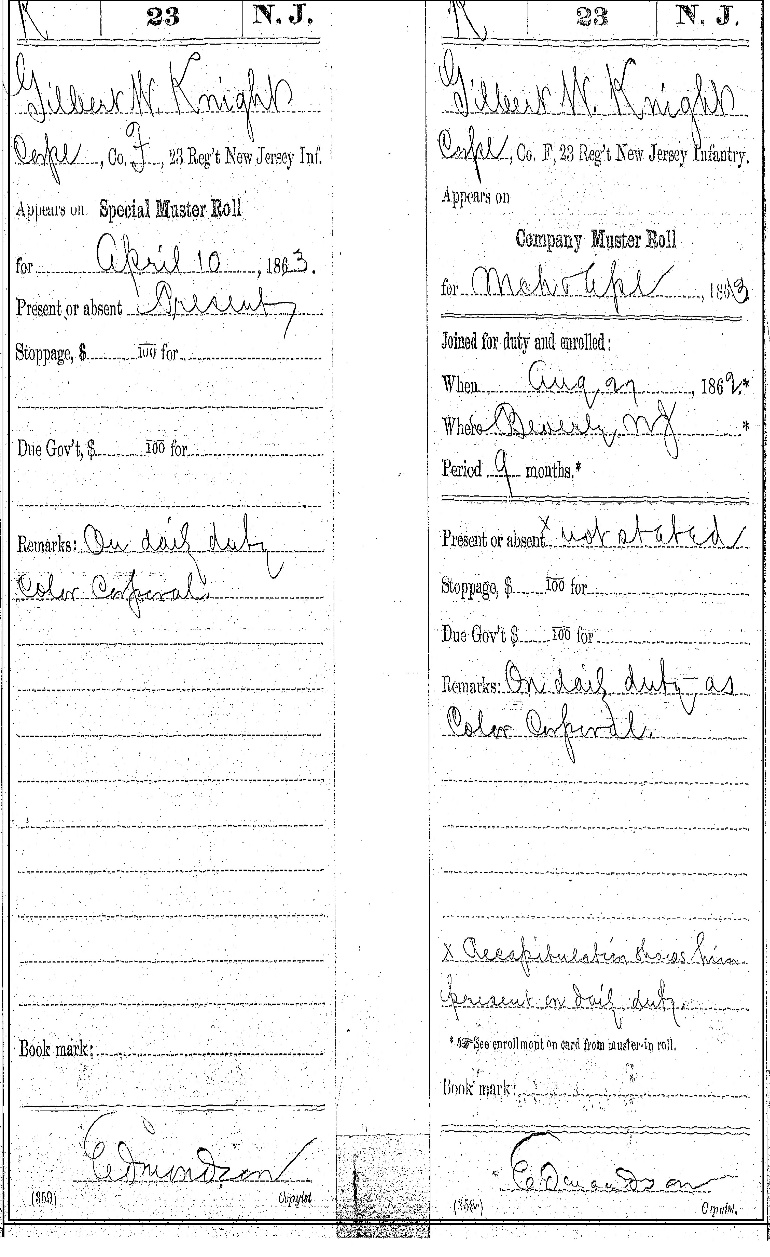
(Gilbert Knight Service Record excerpt)
Timeline
1832: Born in Philadelphia.
1850: Worked as a blacksmith’s apprentice in Philadelphia.
January 2, 1854: Married Hannah Smith in Philadelphia, according to the booklet’s marriage-record caption.
August 27 / September 13, 1862: Enrolled in the 23rd New Jersey Volunteer Infantry, then mustered into Company F as a Corporal.
December 1862–May 1863: Served in the Fredericksburg and Chancellorsville campaigns.
June 27, 1863: Mustered out of the 23rd.
September 8, 1864: Mustered into Company C, 34th New Jersey Volunteer Infantry as a Private.
June 6, 1865: Honorably discharged at Montgomery, Alabama.
By 1870: Following Hannah’s death, married Elizabeth; lived in Shamong and worked as a blacksmith.
1874: Died; his personal property was recorded during probate.

