UNIT: Company C, 23rd New Jersey Volunteer Infantry; Company C, 12th New Jersey Infantry
HOMETOWN: Shamong / Tabernacle; later Medford
BORN/DIED: 1843–1928 (narrative; reported age 86 needs checking)
RANK: Private, promoted to Corporal
GRAVE LOCATION: Old Tabernacle Cemetery, Row 50 Lot 2
Approximate Grave Location:
[GRAVE MAP PLACEHOLDER: Samuel Warner]
Old Tabernacle Cemetery, Row 50 Lot 2
Add an approximate grave-location image when available.

Hear My Story
[AUDIO PLACEHOLDER: Add Samuel Warner’s audio story and replace the links on the icon and “Hear My Story” heading.]

Read My Story
I am Samual Warner. I was born in 1843. I enrolled in the Union army on August 26, 1862. I was mustered in as a Private in Company C of the 23rd NJ Volunteer Infantry on September 13, 1861. I served through the December 1862 Fredericksburg Campaign, and the May 1863 Chancellorsville Campaign, and was honorably mustered out on June 27, 1863.
At the end of my service with the 23rd, I enlisted in the 12th New Jersey Infantry C, as recruit Private on January 2, 1864
In July of 1863, I fought with the 12th Regiment in the battle at Gettysburg. The Regiment had 532 men fight that day; 23 killed were, 83 wounded and 9 reported missing. The regiment fought bravely and is honored by a monument and marker at Gettysburg. The monument reads: “In memory of the men of the Twelfth Regiment New Jersey Infantry Volunteers who upon this field July 2 & 3, 1863, and who elsewhere died under the flag this monument is dedicated by their surviving comrades as an example to future generations.” That day we made two charges on Bliss’s Barn, capturing it. The marker at the site of Bliss’s Barn reads: “ Erected by the State of New Jersey, 1888, in honor of the 12th Regiment of volunteers, a detachment of which in the afternoon of July 2nd, 1863, charged the Bliss house and barn here capturing the enemy’s skirmish reserve of 7 officers and 85 men stationed therein. On the morning of July 3, another detachment of the regiment charged, capturing the buildings, one officer and one man, and driving back the skirmish reserve. The regiment lost in their charges 60 officers and men.”
On May 5th to the 7th, 1864, I fought in what is called the “bloody Battle of the Wilderness.” The battle marked the first stage of a major Union offensive toward the Confederate capital of Richmond. This was the first battle of Lieutenant General Ulysses S. Grant. This battle was part of Grant’s Overland Campaign against General Robert E. Lee and the Confederate Army of Northern Virginia.
Unfortunately, no side could claim victory. After two days of combat, the two armies were essentially where they had been at the start of the battle. The Union army suffered more than 17,500 casualties over 48 hours, thousands more than the toll endured by the Confederates. Despite the costly nature of the battle, Grant refused to order a retreat, having promised President Abraham Lincoln that regardless of the outcome, he would not halt his army’s advance toward Richmond. When we discovered that our new leader—Grant—was to continue to advance, the soldiers rejoiced.
On May 7, Grant directed Union engineers to take up the pontoon bridges at Germanna Ford and then ordered his corps commanders to march toward Spotsylvania Court House. We all know the outcome of that. I was promoted to Corporal on June 5, 1865. And I was mustered out on July 15, 1865. I was recommended for higher promotions for valiant and heroic deeds. On one occasion two other soldiers and I were on the peak of a hill towards which the southern army was moving. We made such a commotion that the rebel army retreated thinking we were a whole regiment. As a result, the union army was able to regain considerable ground that was lost in a previous battle.
When I was mustered out, I returned home to my life as a farm laborer in Shamong and in 1868 married my love, Annie. A year later Annie gave birth to a little boy that we named Wilbert. Annie and I later went to work as servants for Joseph Mathis, a Shamong farmer. Our second child Edward, born in 1877, went with us. Our little son Wilbert had died. In all we had 7 children, but only 3 survived.
In 1890 after 32 years of marriage, Annie and I went to live with our 21-year-old son Thomas and his family in Tabernacle, then we all moved in 1920 to Branch Street in Medford. I worked for Job Braddock for a while on the Braddock homestead. Later, I discontinued farm work and practiced carpentry as my trade. I was 86 when I died in 1928.
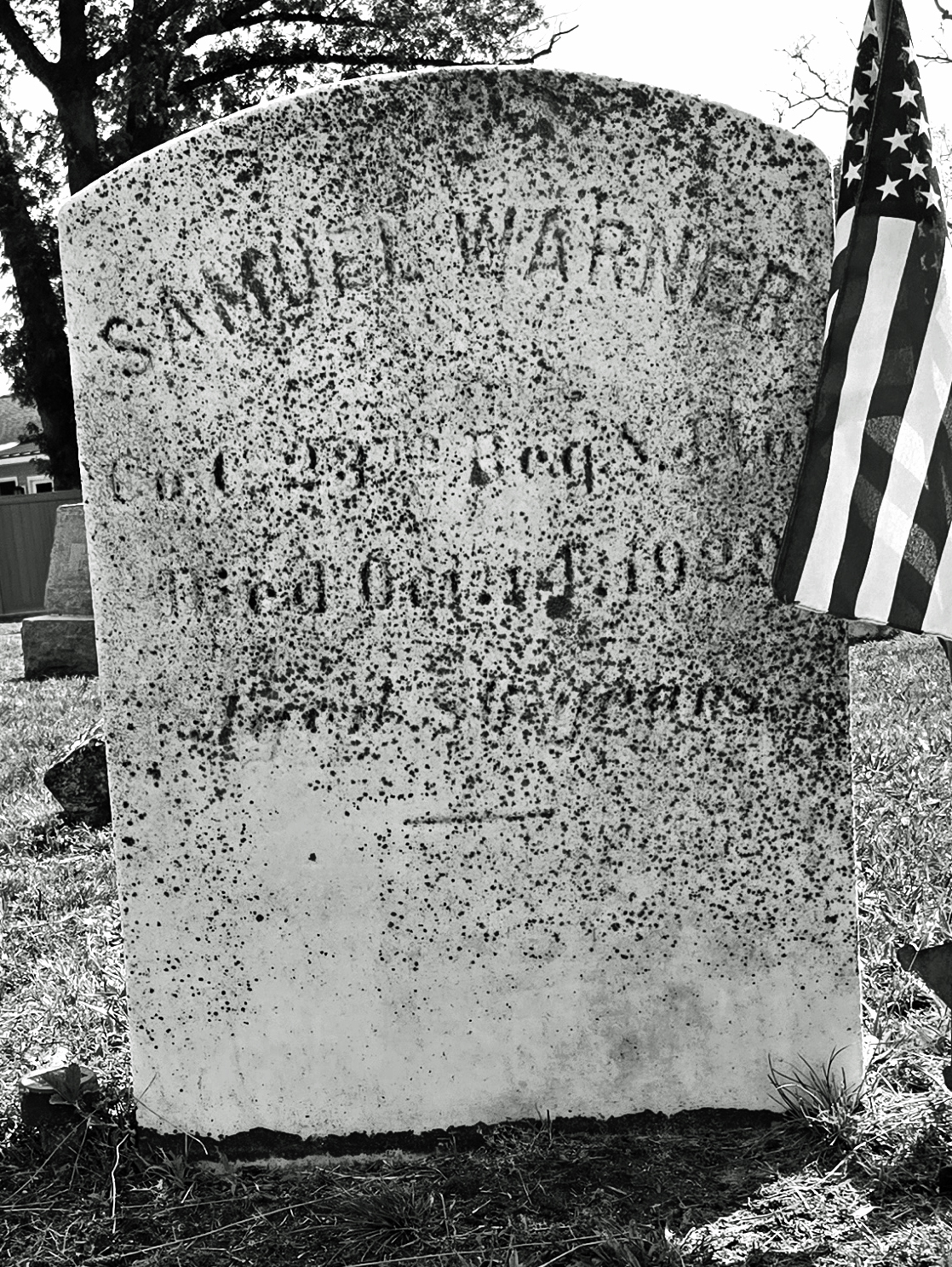
Samuel Warner (Old Tabernacle Cemetery Row 50 Lot 2)
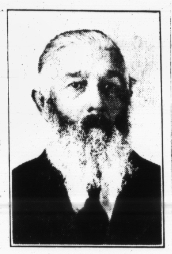
Corporal
Samuel
Warner
Timeline
1843: Birth year stated in the booklet; reported age at death needs checking.
August 26, 1862: Enrollment date given in the booklet. Its stated muster-in date of September 13, 1861 precedes enrollment and needs verification.
December 1862–May 1863: Served with the 23rd New Jersey Infantry in the Fredericksburg and Chancellorsville campaigns.
June 27, 1863: Mustered out of the 23rd.
January 2, 1864: Enlisted in Company C, 12th New Jersey Infantry as a Private, according to the booklet.
May 1864: Fought in the Battle of the Wilderness.
June 5, 1865: Promoted to Corporal.
July 15, 1865: Mustered out.
1868: Married Annie, according to the narrative.
1920: Moved with family to Branch Street in Medford.
1928: Died; the booklet reports age 86.

