
By Rick Franzen
Tabernacle Township has a long history of European occupation. We can document a sawmill operation at Friendship Mill (Camp Inawendiwin today) to about 1715. Over the years as many as eight taverns, inns or hotels have existed, many being established during pre-revolutionary war times. While known then as Northampton Township, Tabernacle when founded in 1901, came from Woodland, Southampton and Shamong townships. This is the story of one of those tavern’s, the White Horse Inn.
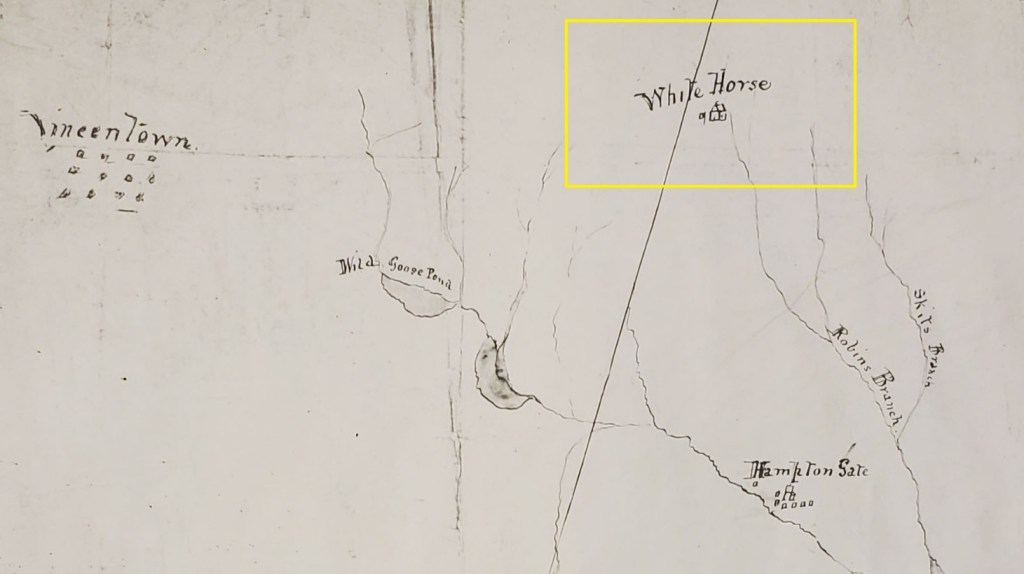
In 1785 Lewis Mingin is reported as the tavern keeper by well-known historian Charles Boyer. The site is located close to the infamous land scandal known as Paisley. At one point, the Tavern may also have been known as Robbins Meadow or Robert’s Tavern.
Here is Charles Boyer’s take on the White Horse Inn.

At the intersection of the road from Vincentown to Speedwell with the one from Red Lion to Manahawkin, was an early tavern. Lewis Mingin is the earliest known tavern keeper at this house and was licensed in 1785 and in 1824, was succeeded by Noah Sooy. It is sometimes referred to as ‘the White Horse Tavern commonly called Robbins Meadows.
Charles Boyer

However extensive research makes no connection to either a “Sooy” or a “Mingin.” Their names appear in no deeds, tavern licenses or other documents connecting them to this site. While Boyer may have documented this, his source of information does not appear in documents available for research. In fact, both the New Jersey State archives and the Burlington County Clerk’s Office state they do not have any tavern licenses from before 1800.
Nothing can be seen at the site today. In fact, its exact location is currently unknown. It is in the area of Chatsworth Road (Route 532) and the Bordentown Gun Club. It’s curious to note that a tavern of the same name exists in Chatsworth and the connection between the two can only be speculated. However, some have said it is possible that the later tavern was constructed after the former burned down and was named for the earlier one. Reportedly a James Delette owned the former and built the latter.
During 1808 Daniel Joyce purchased many properties from Abraham Matson. The price is $1000. While this deed does not specify a house or inn, a White Horse deed of 1828 indicates the land was once owned by Abraham Matson. Matson, in turn, made many purchases of land in the 1790’s. One deed, recorded in 1797, does mention his house, but makes no reference to an inn or a hotel. The land, near Tom Robbins Meadow, contains some 85.83 acres
In 1827 Daniel Joyce issued an assignment deed. Apparently he was financially underwater and needed help to pay his debts. Among those to whom he owed money were Edward Bound ($2508), Thomas Budd ($2465) and William Irick ($300). Part of that deed, noted below, fails to mention a Township, but the name on the deed and the reference to “White Horse” confirm this is the Tavern property.

By 1828 the land was resold to Daniel Joyce. Included in the 500-acre property description is the phrase “that tract of land with the Tavern House and other buildings,” and “called the White Horse.“ There is also mention of the Green Limb Swamp, later the site of a turning mill. The deed also mentions that the property once belonged to Abraham Matson.

(Burlington County Deeds Book W2 Page 498 1828)
New Jersey State Supreme Court case records from the early 1800’s are available at the State Archives. Unlike today, these records seem to deal with mostly debt, trespass and appeal of debt. If a trial is held, we are given the names of plaintiff, defendants, witnesses, jurors,” officials” and others participating in the case.
Allen Joyce was involved in one such case during the year 1828 (Case # 29964). Allen was a defendant in a suit brought by the plaintiff Stacy Prickett. While the outcome has not been researched, it appears that Joyce was charged with “trespass and ejectment.” This type of case is described as an action to have someone removed from your property.
Some 17 years earlier Allen Joyce took part in a trial. He was a juror. This interesting case (Case # 12242) was a complicated situation involving a slave of one Isaac Budd named Ishmael Still.
From the record we have “Isaac Budd testifies that Ishmael was given to him by his father in his will, and that he never manumitted him because Ishmael was too old, but that he has let Ishmael go as a freeman and work for himself, make contracts, recur wages and pay debts, to sue and be sued in his own name, for himself this thirty years last past, which is generally known in the neighborhood.”
It was Ishmael Still who was the defendant while one Anthony Earl was the plaintiff. Still had been sued by Earl for $50.00 on bills from 1804 and 1805.
The type of State Supreme Court cases today is certainly far different than those of the early 20th century. And it is such a good thing. We can closely monitor the comings and goings of our forefathers and gain an intimate understanding of life in that time.
Gordon’s 1833 map names “White Horse” and may show a structure on the road to Hedger House. This location is also mentioned in the 1888 deed when H L Freeman purchased the property. While this map does show the Hedger House, nothing shows any hotel structure in today’s Chatsworth.

(Gordon, Thomas, A Map of the State of New Jersey, Revised 1833)
In his 1833 will Daniel Joyce does not address to whom he will bequeath the property. Rather he says, “sell and dispose of all of my estate and real property.” He does, however, not leave anything to his son Allen, as “he has already received his full share.” Daniel Joyce dies in 1835.
An advertisement in 1835 indicates the property is for sale.

(21 May 1835, New Jersey Mirror)
And later, in 1835, the White Horse property was sold at a Sheriff’s sale for $400. The buyer was Allen Joyce. Within the deed we see references to the “White Horse Tavern property,” and “ the tract of land with the tavern house.” The various lots contain 500 or so acres and were purchased from Alan Matson in 1808.
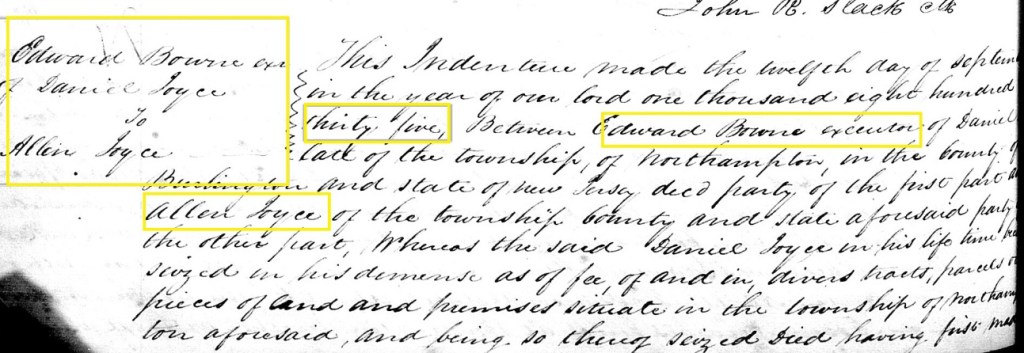

(Burlington County Deeds Book L3 Pages 430 and 431 1835)
While Roger’s 1839 map shows no owners’ names at White Horse, nor a road up to Hedger House, it does seem to locate a structure at the same place as Gordon’s map. Hedger House is not shown, and “Chatsworth” is labeled as “Union Works.”
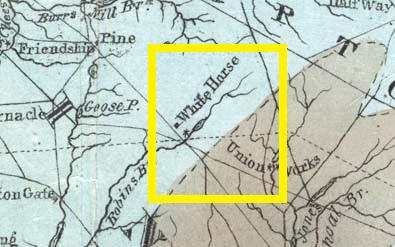
(Rogers Henry D, A Geological Map of New Jersey, 1839)
An 1839 advertisement for 2000 timbered acres is listed for sale between Lewis Mingin’s Tavern and Bispham’s Upper Mill. The 1840 map confirms this graphically, and the ad seems to confirm that Lewis Mingin still owns the property. While the property is now owned by Allen Joyce, it still could be called Lewis Mingin’s Tavern.

(26 October 1839 New Jersey Mirror and Burlington County Advisor)
An undated, unsourced map circa 1840 clearly shows the White Horse Inn. No road to Hedger House is apparent, but the structure’s location suggests it could be in the same location as previous maps indicate.
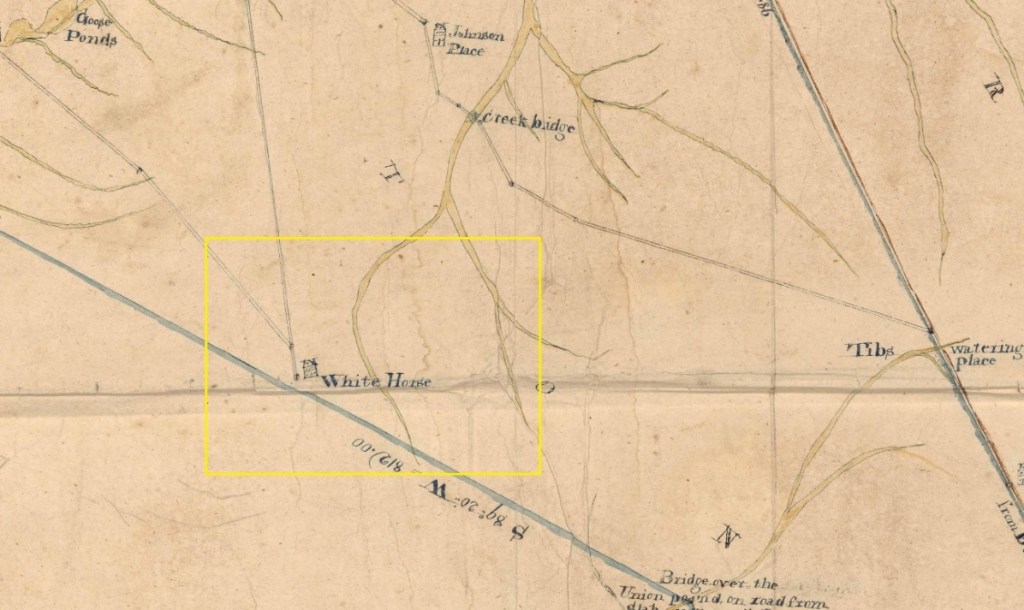
(Undated, Unknown map of Burlington County, circa 1840)
In 1849 Otley and Whiteford publish a Burlington County map. It is very clear about a hotel at White Horse.

(Otley JW and Whiteford R, Map of Burlington County, Published by Smith and Wistar, 1849)
In their 1859 map Kuhn and Janney identify the White Horse Hotel. The road to Old Union Forge (Chatsworth) from Tabernacle is noted as very similar to the road of today.

(Parry W, Sykes G and Earl F W, New Map of Burlington County, Published by R K Kuhn and J D Janney, 1859)
This map of Washington Township continues to confirm the hotel’s existence. Only the road from Tabernacle is shown.
(Burlington County, Washington Township Map, Burlington County Historical Society, 1862)
Allen Joyce died in 1868. In his will he states his property shall be sold and the proceeds given to his children and grandchildren as designated in the will. He does designate that two of his unmarried daughters shall each be given a room “in the house.” It is not clear if this is the hotel property or another house. However, they are also given use of the “water pump, cellar and firewood.” Each male child has received about 55 acres of land and cash. The female children and four grandchildren also receive a cash payment.
In the official county probate records we see that the value of the estate is $8310.45. This includes the $1346.94 James Delette paid for “real estate at Whitehorse.” The list of real and personal estate values is rather long. It contains such items as cows, pigs, turkeys and chickens.
Sometime in 1881 Job Joyce, now living in Ohio and a son of Allen Joyce, filed an appeal over the estate recording of incomes and expenses. He believed that over $1000 was not reported correctly and that he was entitled to additional funds. A three-judge panel denied his request.
In 1869 the land was sold to James Delette for $1346 at an Executors sale. It contains at least six parcels of land comprising some 215 acres and contains the phrase “the white horse property.” The property is being sold on behalf of Allen Joyce.

(Burlington County Deeds Book A8 Page 577)
By 1872, a Rutgers University map positions the White Horse Hotel between Shamong Station (Chatsworth) and Tabernacle. The road up to “Pine” and the Sooy Place Taven is clear. No hotel or tavern is shown in Shamong Station.

(Beers, Topographical map of Southern New Jersey , Rutgers University, 1872)
We can confirm that James was a hotel keeper in 1874 as he is recorded that way in the Shamong Township birth records. Daughter Ella was born on March 16 of that year, and James is listed as “hotel keeper.”
A forest fire reported in 1875 seems to be the demise of the hotel. But the 1877 Cook map does refer to a hotel. The map may have been in preparation and did not reflect the event. And the Scott map of 1876 only lists the property as “James Delette’s. There is also an 1894 newspaper article which suggested the fire occurred about 1869 and that the Hotel was built as early as 1744 (New Jersey Mirror 28 February 1894).
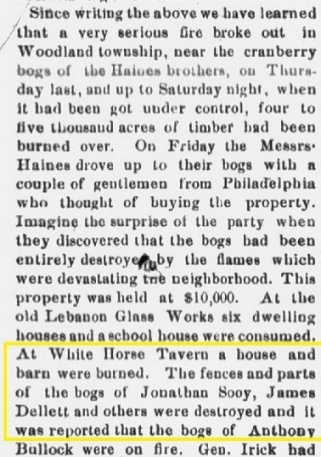
(27 May 1875, New Jersey Mirror)
In the popular 1876 Scott’s Atlas, no hotel is noted. And in Shamong Station, a James Dellett is a property owner.

(Scott JD, Historical Atlas of Burlington County, Reprint of the Pemberton Township Historic Trust, 2002)
But a year later Cook and Smock do point out the Hotel.
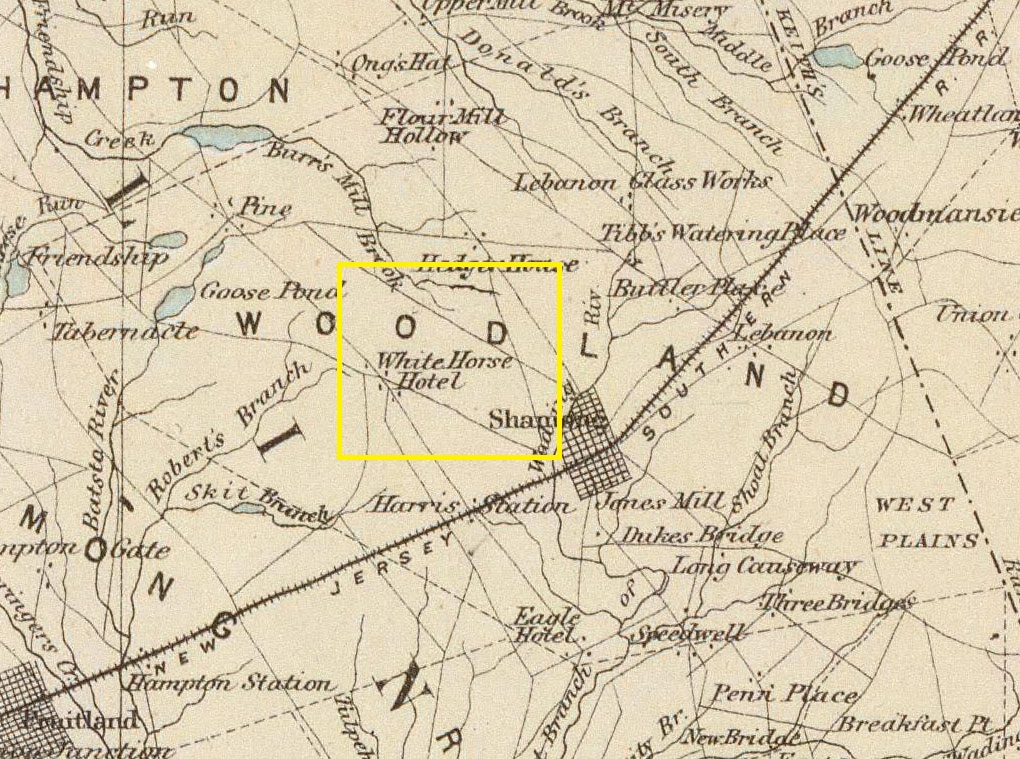
(Cook G and Smock J, The State of New Jersey, 1877)
An 1889 map by Kobbe does show the three major routes which have been associated with the White Horse Hotel. Clearly drawn are the roads to Tabernacle, Shamong Station, Sooy Place and Hedger House.
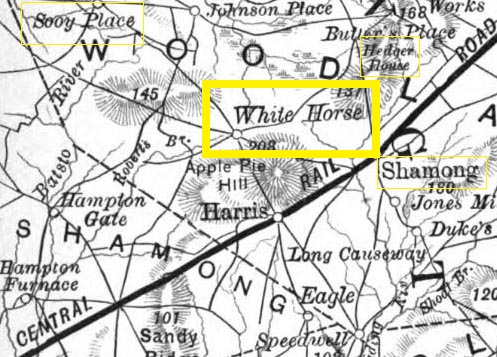
(Kobbe Gustav, Jersey Coast and Pines, 1889)
In 1898 Dellett sold the property to Constant LeDuc. It is the same Property bought in 1869.
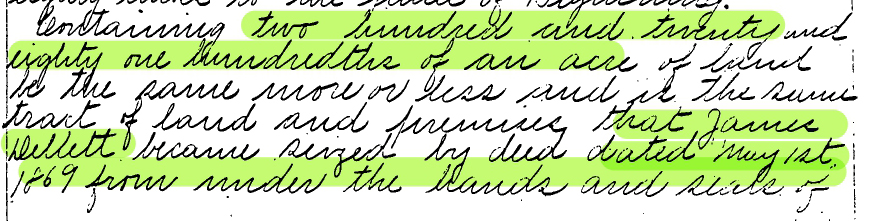
(Burlington County Deeds Book 339 Book 451)
An interesting parallel is shown in the 1860, 1870, and 1880 censuses. A John Dellett is listed as “an inn keeper,” “keeps hotel” and “keeps a saloon” as a resident of Woodland Township. Since restored White Horse Hotel in Chatsworth was constructed circa 1860, it’s reasonable to assume that John Dellett was the owner of this hotel.
John Dellett was born in 1824 and died in 1892. He was the son of a James Dellett who died in 1850. In 1863 his name appears on the “draft list” and he is mentioned as an ”inn keeper.” One of John’s children was also a James, and he was born about 1850. This James was quite possibly the owner of the original White Horse Inn, and he obtained ownership of it about 1869. If so, the general consensus that the Chatsworth White Horse was built after the Tabernacle White Horse Inn does come into question.
By 1888 H. L. Freeman begins his infamous land fraud at Paisley. In several of his acquisition deeds for the Paisley land scheme, we see many references to the White Horse Tavern. They are couched in terms of landmarks which signify property boundaries. We read the following “goes along the road where the Old White Horse formerly stood,” “where the Old White Horse Tavern formerly stood,” “goes along the road from the Old White Horse Place to Sooy Place,” and “old Sooy Place to White Horse.” So, by 1888 the Tavern was long gone.
The White Horse Tavern land which was incorporated into the land fraud was sold to Freeman’s surrogate Constant LeDuc by James Delette’s executors in 1898. The cost was $500 and the property was on the road from “Hedger House to the White Horse.” Over 220 acres were purchased and the deed notes that these are the lands purchased by James Delette in 1869.
By 2025 nothing hints that a hotel once stood in the area of today’s South Park Road (the road from “Pine”) or the road that once led to Hedger House. However, the landscape in the area suggests a former development of some type. Rather than huckleberry bushes covering the ground, the area is open, grasses cover the ground beneath pines and oak trees. It certainly shows how nature reclaims its land when man abandons the area. This is what it looks like today.
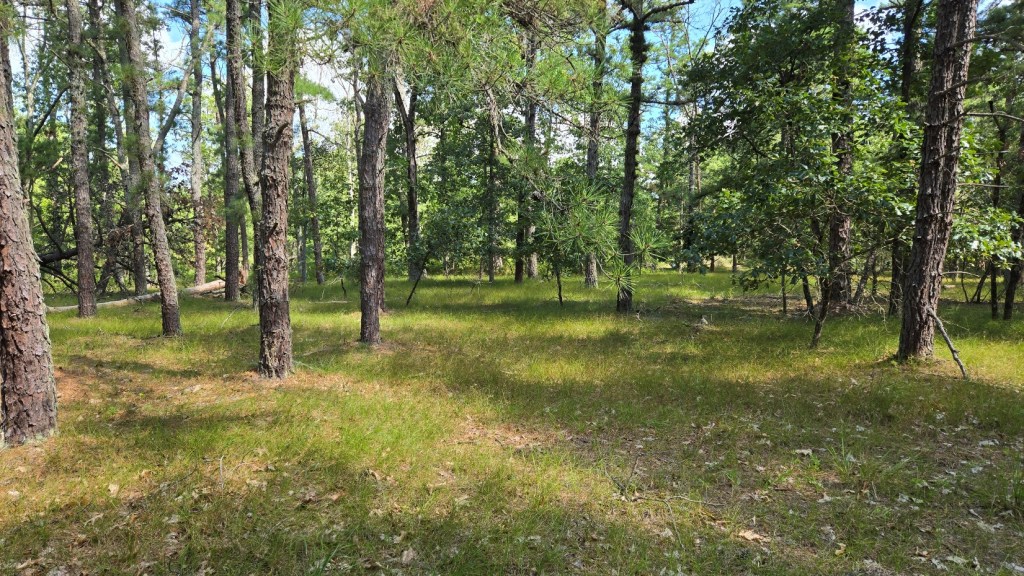
(photo by Rick Franzen)
 Tabernacle Historical Society