
By Rick Franzen

Sometimes you just never know what you may find. The Cramer property on Old Indian Mills Road in Tabernacle has long been known as one of the older homesteads in town. Yet it has never been known as a “tavern”, “inn” or “hotel.” No Tavern licenses have been located for it nor is there any local lore concerning it. This all changed recently when advertisements were found in old New Jersey Mirror newspapers listing it as a “Hotel” and place of public sales at least during the years of 1839 to 1845. Several advertisements mention the Tabernacle Hotel, then the residence of Eli Cramer.
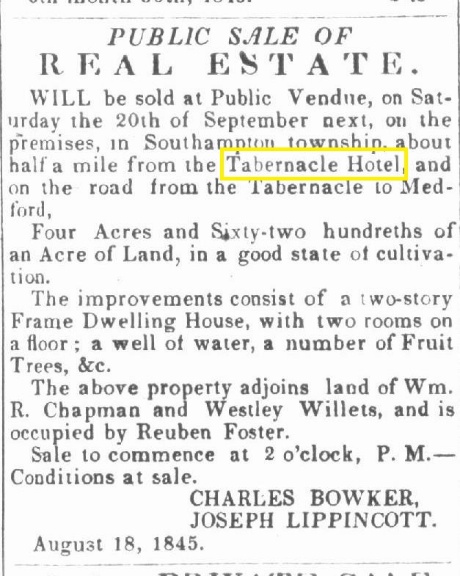
Eli Cramer Sr was born in 1780 and died in 1848. Father of nine children, he had inherited the property from his father Caleb in 1820.

The deed for the property in 1820 shows:
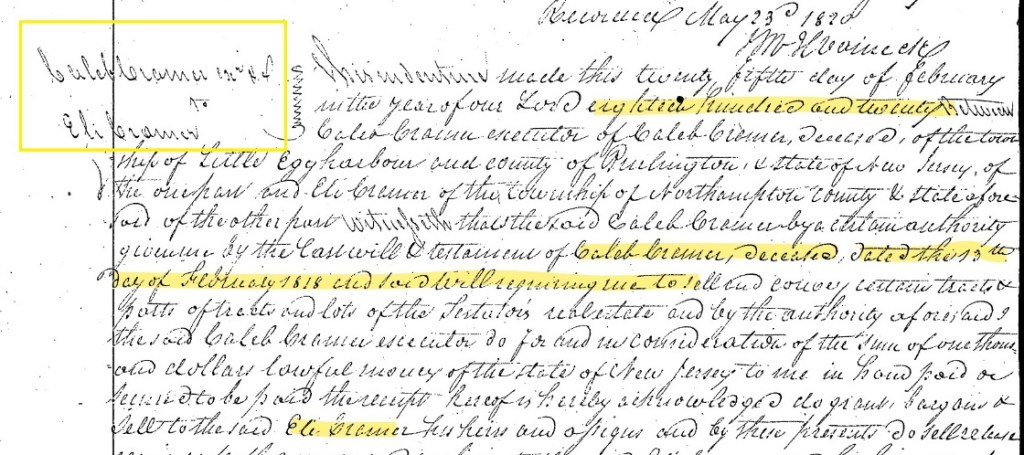
Caleb had purchased the property from Jacob Alloway in 1806 for the sum of $800. This price leads one to believe that there could have been a building on the site. In addition, the deed states “where said Jacob now dwells, “ and “ all that plantation.” So, the building could date to the late 18th century. This deed also shows the property size reduced from the Alloway deed.
Jacob Alloway, according to an 1806 deed, had purchased the property from John Moore in June of 1792. That deed has not been located. But the 1806 deed references a prior 1780 deed.

Later deeds for the property show that it contains 48.7 acres. It appears that in the 1820 deed only about half of the property was transferred to Eli Cramer Sr. In 1843 Eli Cramer Sr. transfers the property to his so Eli Cramer Jr.

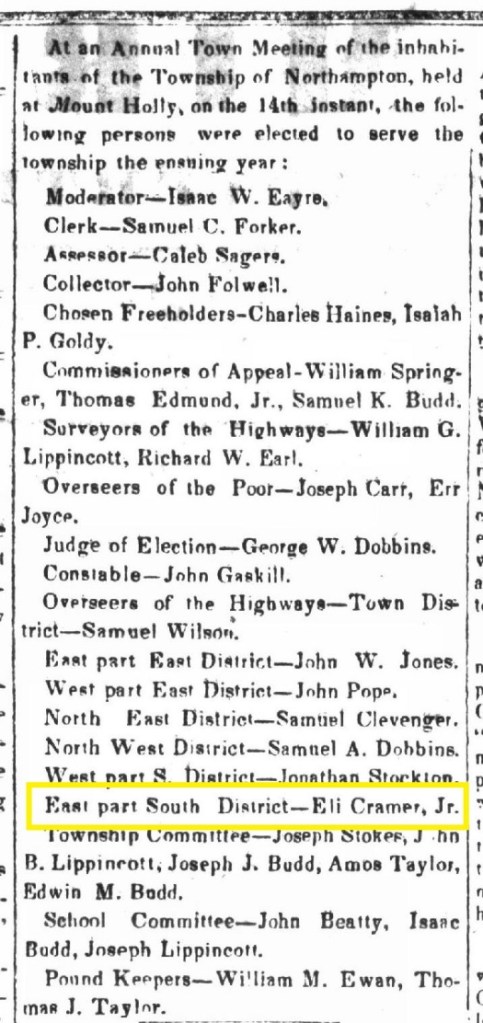
Another interesting thing happens in 1843. We see that Eli Cramer is elected as the “Overseer of the Highways for the East part South District in Northampton Township.” Northampton is one of the original townships in Burlington County . Other townships associated with the 1901 creation of Tabernacle Township prior to 1901 were (Woodland (1866), Southampton (1845), Shamong (1852), Washington (1802), Medford (1847) and Evesham I1688). Medford was carved from Evesham, which was an original township.
A circa 1840 map not only shows Eli Cramer’s house but also the names of many nearby roads, houses and geographic features. Eli’s road is named after the nearby residence of Samuel Taylor. Also clearly identified are the Fox Chase Hotel of Hosea Moore, the Sign of the Eagle Hotel of Alanson White and Friendship Mill.

By 1849 mapmakers refer to Cramer’s property without the designation of it being a hotel. In this map it appears that both Eli Cramer and his father Caleb live in close proximity to one another. The map is not in a north-south orientation, and this does skew any viewing of it.
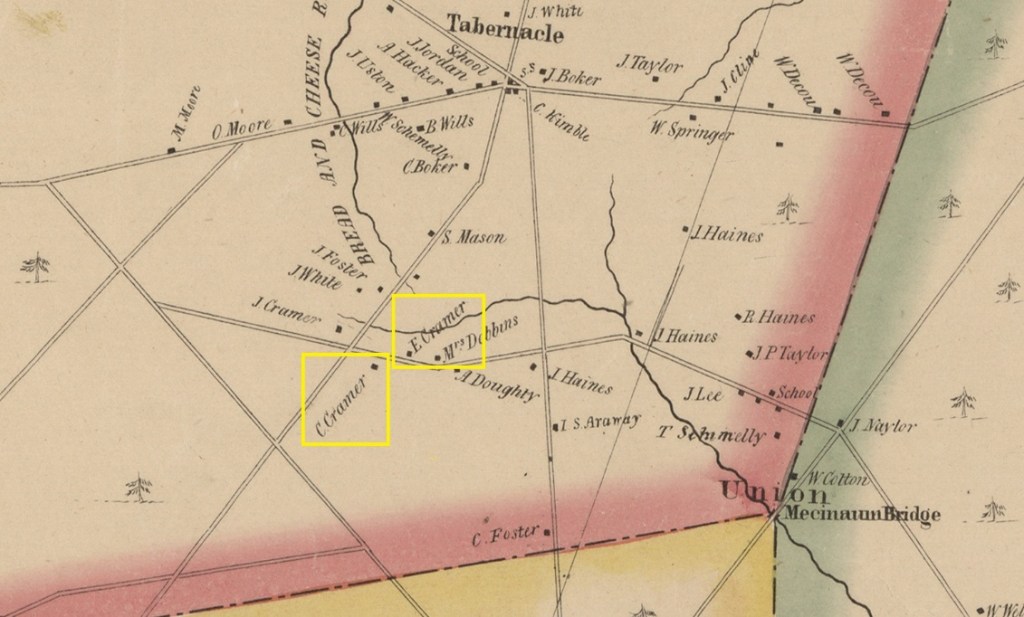
The next map which shows the area, in 1859, lists three different “Cramer” landowners. Since the original Caleb died in 1818, and his son Eli died in 1848, these are not the same individuals. Two of Eli’s sons were named Caleb and Eli, so this would be them. The third Cramer, “J. Cramer,” might be another son of the first Eli. “J. (John) Cramer” also appears on the 1849 map.

Scott’s 1876 Atlas shows an updated ownership listing for the Cramer family. Now we just see Eli and an I Cramer living in the area. The full map also depicts the Bread and cheese Run as traveling from Indian Mills Lake to Friendship Mill. This is not accurate as the Bread and Cheese run begins on the Cramer property.
Early references in various deeds seem to indicate that the first name for Bread and Cheese Run was Haines Mill Creek. However, the circa 1840 map indicates it as “Bread and Cheese Run.”

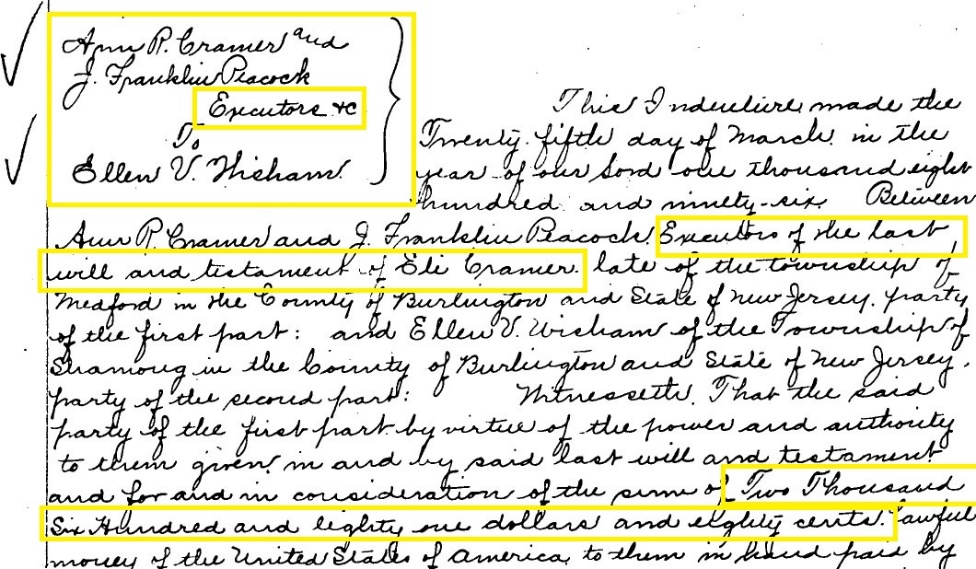
The Cramer family, through Eli Jr. and others, maintained control of the land until 1896 when his estate sold it to the Wischman family.
New Jersey State Supreme Court case records from the early 1800’s are available at the State Archives. Unlike today, these records seem to deal with mostly debt, trespass and appeal of debt. If a trial is held, we are given the names of plaintiff, defendants, witnesses, jurors,” officials” and others participating in the case.
The Cramer family was a frequent user of this system. Here are a few examples.
In 1807 Caleb Cramer (Case # 6556) is the plaintiff wherein he sued Richard Churchwood for trespass. Just a year later in 1808 (Case #9204) he again is a plaintiff. This time Joseph Wilson is the defendant in a “appeal of debt case.” And in 1817, a year before his death, Caleb was “enjoined in bond” in a suit between Noah Sooy and James Giberson. “Enjoined in bond” refers to a court order in which one has to refrain from certain actions or has to take certain actions.
We also note that Caleb was a Justice of the Peace in a few cases (Cases # 34376, 36765 and 15189). The records show that he oversaw some cases on “appeal on trespass” and “appeal on debt.”
Eli Cramer follows in his father’s footsteps and become a second-generation user in 1829. He sued Issac Yates in a case labeled “appeal of debt” (Case #9278).
And in 1833 Grandson Caleb began his adventures with the Court system. In that year he filed four trespass complaints (Cases 6666, 6667, 6668 and 8000.) Three were against family members Issac, Charles and Uriah Cramer. The fourth case was against Amasa Mathis (Case # 8000) for “trespass and ejectment.”
Caleb played another role in an 1839 case (Case # 15247). This time he is a juror in the “appeal of an unlawful detainer” wherein John Horner had sued one James Burk.
The Cramer family, with its court involvement, was following a trend the previous property owner had started. In 1803 Jacob Allooway has sued Hosea Moore for an unpaid debt in the amount of $2528.00 (Case 887). And just a year later he was a participant in a suit (Case #93) against Joshua Alloway. The family connection between the two is unclear.
In 1803 we see a Supreme Court case (Case #93) in which there appears to be an intra family squabble with the Alloways. Jacob Alloway, as the plaintiff, sues Joshua Alloway. And Elijah Alloway is “Surety” for Jacob. A Surety guarantees payment if the defendant cannot secure the funds. It is not clear if these three siblings are arguing among themselves, or if Jacob, their father is involved. We also see the familiar names of Hosea Moore, Amos Springer and Alanson White as referees.
The case is “a certiorari,” meaning the higher court (Supreme) has asked the lower court (a Justice of the Peace) for the file so it can be reviewed. While the available court papers are not complete, it does seem as William H Burr was the lower court judge who rendered a decision against Jacob Alloway. There are eight reasons given for the appeal. A few of the more interesting ones are reconstituted below.
“Because the said Alanson White who was chosen as umpire was not duly sworn in or affirmed as by law he ought to have been.”
“Because the said Referees have acted corruptly and partially in making their awards contrary to the evidence before them.”
And (summarized) because the said Jacob Alloways in 1798 had settled his account, he had given five pounds and five shillings to Joshua and that the Referees had arbitrarily made the award of funds without considering this.
Wow. While no final decision is on the record, we have an excellent view of colonial life
in the Tabernacle area.
The type of State Supreme Court cases today is certainly far different than those of the early 20th century. And it is such a good thing. We can closely monitor the comings and goings of our forefathers and gain an intimate understanding of life in that time.
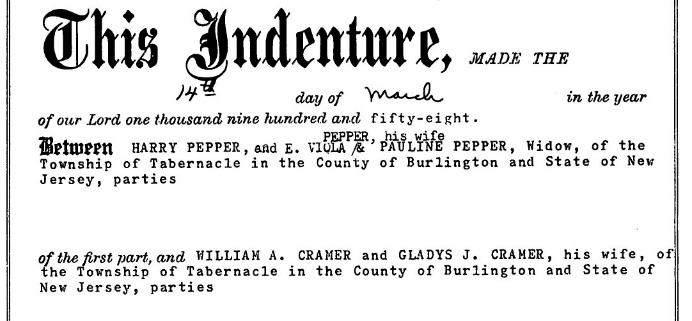
The property stayed with the Wischman’s for just eight years until the Pepper Family purchased it. Two Peppers, John and later William own the land until 1958. Then, after some sixty-two years it returns to Cramer ownership. It was purchased by William and Gladys Cramer, and their descendants continue to own the property today (2025).
In 2025 the house is in excellent condition. The foundation has been rebuilt, and it maintains a strong presence on “Taylor Town” Road. For years to come it will continue to be an excellent example of an early nineteenth century local homestead.
 Tabernacle Historical Society