
(Tabernacle Hotel and Farm)
(Sign of the Eagle)
By Rick Franzen
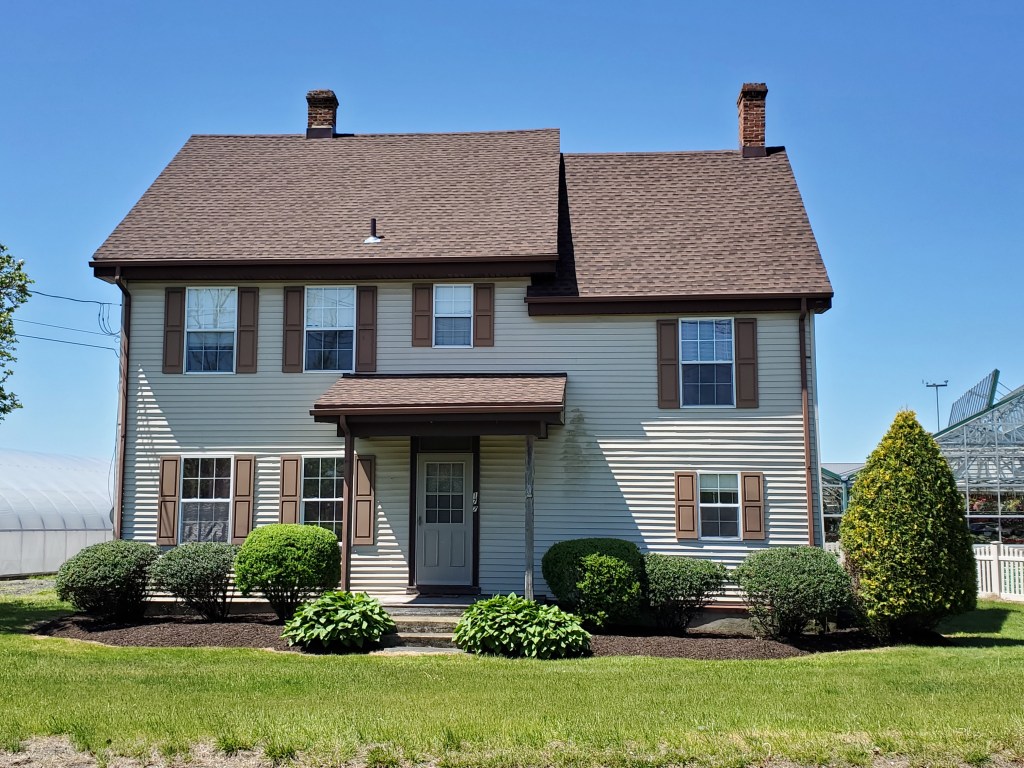
The earliest reference to a house/hotel on this site seems to be when Benjamin White owned the property. Born about 1755, he lived till sometime close to the 1820’s. Benajamin was a Revolutionary War soldier who served with the First Regiment in New Jersey. He was from Shrewsbury in Monmouth County.
It is not clear when he acquired the property. Early deed indexes before 1809 are not readily available. Later indexes do show property acquisitions, but none are the property in question. And the records of the West Jersey Proprietors contain no relevant Benjamin White information.
New Jersey State Supreme Court case records from the early 1800’s are available at the State Archives. Unlike today, these records seem to deal with mostly debt, trespass and appeal of debt. If a trial is held, we are given the names of plaintiff, defendants, witnesses, jurors,” officials” and others participating in the case.
The White father and son duo, Benjamin and Alanson were familiar with this process. Benjamin, in 1809, was sued by one John Lacey for “Trespass on the Case” ( this is an action which allows a person to seek monies for indirect harm caused by another’s negligence)(Case #24040).
And in 1812 Benjamin, in return, sued Lacey for the same (Case # 45489). The outcome of either suit has not yet been researched.
These were not Benjamin’s only court involvements. He was a juror in one case (Case # 35744) which drug out for two years, 1801-1803. And from 1792 to 1796 he was a juror in a debt and mortgage bond case (Case # 36101).
Son Alanson was also a defendant in a “appeal on trespass” case in 1810. The plaintiff was one John Butterworth.
But his biggest case involved someone who appears to be related to a later owner of the Kemble Inn. Alanson sued Joseph Kimble (Case # 45312) in 1808 on a debt appeal. The case was heard by JP William H Burr and involved some forty plus people. At that time Joseph Kimble was deceased. The spelling difference between “Kemble” and “Kimble” is not significant. Variations of name spellings in this time period were common.
There were 12 jurors, 6 officials, 6 witnesses, some 20 “named in case” and the plaintiff and defendant. Those named in the case seem to have been others who had judgements either for or against them. What a sight this trial would have been in the old Mt Holly Courthouse. Some familiar names were Aaron Barnhart, Francis Bodine, the Burr family, Revel Elton, William Foster, Jesse Richards and Nicholas Sooy.
The appeal was partially based upon actions taken by the deceased Constable. After a trial on 13 December 1808, the jury found for the defendant in the sum of $21.38 and $5.50 cents court costs. The plaintiff, Alanson White, paid on the spot.
The type of State Supreme Court cases today is certainly far different than those of the early 20th century. And it is such a good thing. We can closely monitor the comings and goings of our forefathers and gain an intimate understanding of life in that time.
When Benjamin White died about 1826, his daughter Elizabeth Mathis petitioned the Orphan’s Court to disperse his estate since she was one of the executors of his will. His 100 acres or so were in the Township of Washington. The nine children listed are David, Elizabeth (wife of Daniel Mathis), Reuben, Alanson, Mary, Benjamin, Ann, Rebecca and Edith. Although his will stated “the estate shall be sold,” in 1825 the executors deeded the property to Alanson White. And in a document dated 1829/1830, Alanson is listed as one of many tavern owners in the area.

Alanson ran the Tavern until his death in 1838. He died without a will, in debt and with at least six children. An ad appears in the 12 January 1843 issue of the New Jersey Mirror setting a sale date for the property. The land is described as “that certain Farm and Tavern property known as the Tabernacle Hotel and Farm.”

An 1830 road return (the creation of a new road) for a road from Retreat to Flyatt labels Alanson’s Tavern on today’s Carranza Road (Old Hampton Road). Not on the map is the Old Tabernacle Cemetery. We can also see Friendship Mill, as well as the road from Red Lion to Sooy’s Tavern.

In 1834 a public sale was held at Alanson White’s Tavern. Ironically, it is called the “Sign of the Eagle.”
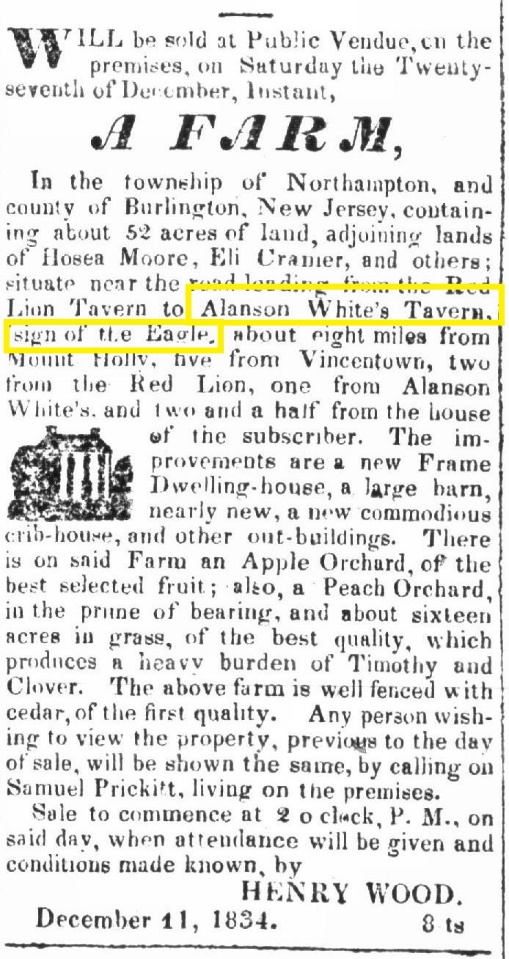
As early as 1840 a map exists which shows the location of Alanson White’s Tavern.

By February of 1843, Sheriff Hillard held the public sale and the property (about 100 acres) is deeded to William Irick and Joseph White. The land is described as Alanson White’s Tabernacle Hotel on the road from Red Lion Tavern to Hampton Gate. The buyers paid $1935.
In 1845 this structure was owned by Charles Kemble. In addition to his innkeeping, Charles was a blacksmith and farmer. He also served as a member of the NJ State Assembly and the Sheriff of Burlington County.
Charles had purchased the property in January of 1845 from William Irick as well as Joseph and Elizabeth White. At the time the property is in Northampton Township and is “the land known as the “Tabernacle Tavern property.” One property line begins at a stone corner of the Tabernacle Meeting House. It is on the eastward side of the Goose Pond Road (now Chatsworth Road) and Hampton Road (now Carranza Road) is nearby. It contains 76 and 12/100ths of an acre and cost $575.
In the same deed, Charles also purchases 10 and 62/100ths of an acre. This is the first time we see a reference to five lots on the property.
The earliest census we see Charles Kemble appear in is the 1850 census. He is listed as a farmer with a land value of $2500. With him is his wife Sarah and three children. In 1860 his child count rose to seven, while his property value has dropped to $2000. In the NJ census of 1865, he still appears in Shamong, but by 1870 is living in Northampton. His occupation has also changed, as he is now the County Sheriff.
In October of 1853 the County Whig party holds a convention at Kemble’s Hotel. Their purpose is to select a candidate for the ensuing legislative election for the fifth District.
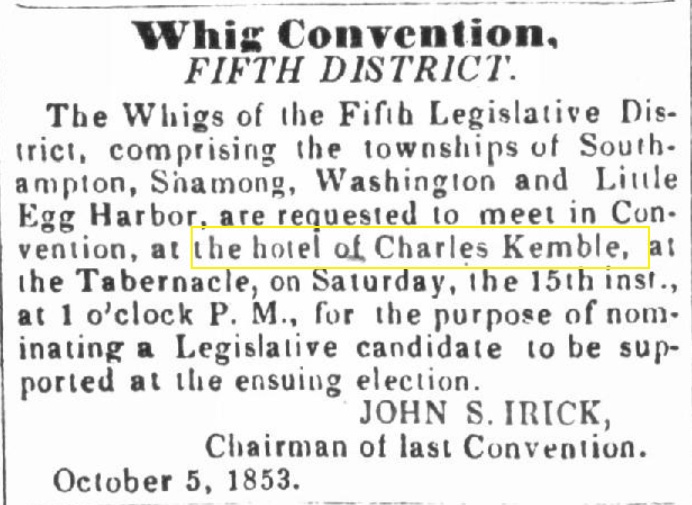
All of Kemble’s original tavern licenses from 1855 to 1860 have been preserved. The 1856 license is granted at “the Tabernacle in the township of Shamong” for $12.00. Interestingly enough, the property is listed as “the Tabernacle.” This is a frequently seen description, in these early years, of the early church in today’s Tabernacle.
Eli Bowker testifies that one “freeholder,” Stephen Haines, is not a resident of the township (Shamong). The complete list of signers is:
Wesley Taylor
Henry Smith
Eli Bowker
Joshua Jones
Caleb Wright
Josiah Huston
Benjamin Willets
Henry Kemble
Ebenezer Davis
John Alloway
Gilbert Swain
Joel Carmely
Stephen Haines
William Carmely

By 1860 the cost of Kemble’s license had dropped to $10.00. This is not the last year of his proprietorship, as in 1866 he is listed in the Talbot and Blood Directory, as a hotel owner.

An 1867 newspaper article shows that Charles Kemble and his neighbor are selected as “agricultural delegates” to a convention in Mt Holly. They represent Shamong Township.

In 1869 the New Jersey Mirror reports that Charles Kemble will be a “Temperence candidate,” and that “the rum traffic will be completely crushed out.” He was elected as the County Sheriff but it does not seem that he crushed the consumption of alcoholic beverages.

From 1855 to 1859 he served in the New Jersey Assembly and in 1869 he was elected Burlington County Sheriff. He passed away in 1872 and was buried in St Andrews Cemetery in Mt Holly. The 1876 Scott’s Atlas depicts an S C Kemble as the owner of the property. This would be his wife Sarah Campbell Kemble.
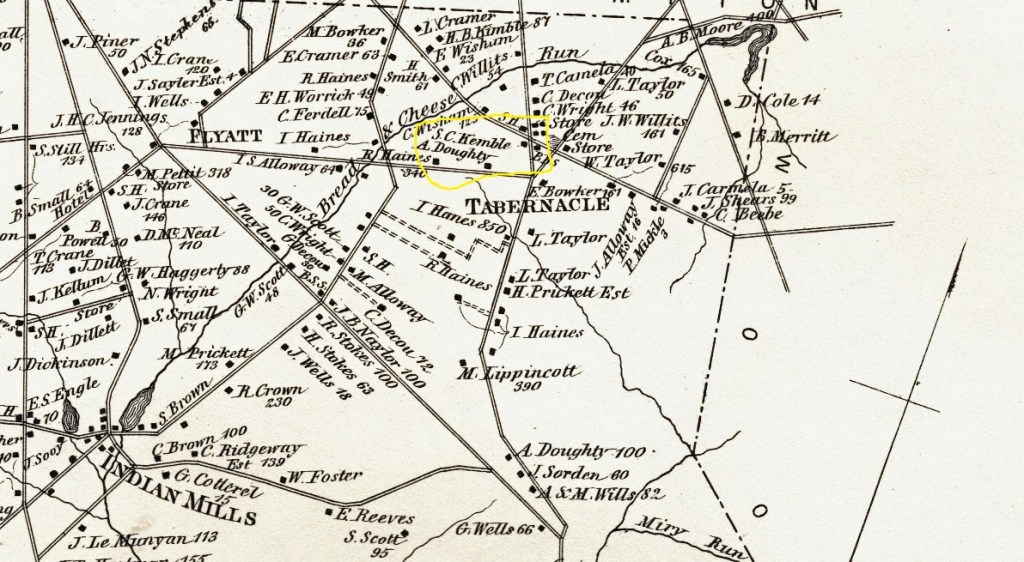
In September of 1887 the New Jersey Mirror lists the property for sale.
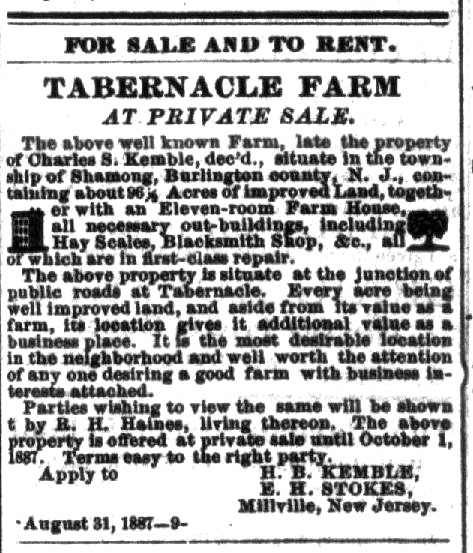
In January of 1890 the heirs of Charles Kemble, led by his widow Sarah Campbell (SC), sold the property. The property is described as fronting on the road from Ballenger’s Mill to Goose Pond (today’s Medford Lakes Road). It was sold to Richard Henry Haines for $6100 and contained 81.14 acres. A second lot in the deed contains 10. 7 acres and a third lot has 25 acres. Later deeds for these properties show about the same amount of acreage, but in five separate lots.
By 1905 the land passed on to Albert V Hughes. The price for the five lots was $5000. The total acreage is just over 121 acres.
Then in 1920 Victor M Allen purchased the property for $11,000. He had lived in Virgina and moved to Tabernacle after a notorious event occurred in his hometown. It was Victor who started the first dairy farm on this site of the old tavern.

In 1946 the land was sold to Melvin Fletcher for $11,500. He continued with the dairy farming. In 1967 it was purchased by the Russo Family, and they eventually expanded their farmlands by hundreds of acres to become the largest farm in Tabernacle.
Along with the Tabernacle Hotel site, the Kemble Inn (also known as the Sign of the Eagle) survives as another outstanding example of an early 19th century gathering place. It has been preserved by the Russo family and adds to
 Tabernacle Historical Society