
By Rick Franzen
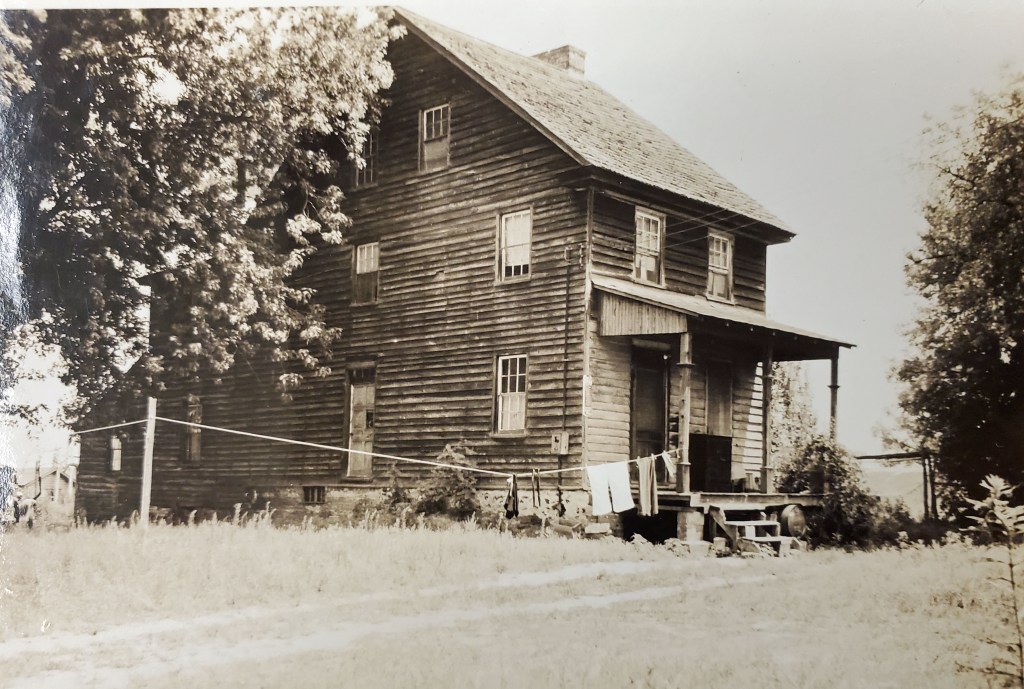
(Ewan, Nat, Photographic Collection at Burlington County Historical Society)
Built prior to 1800 by William Fox. By 1830 Hosea Moore was the owner. Hosea Moore’s name appears on a list of tavern owners dated 1829/1830. The building caught fire and burned in the mid 1950’s. Virgil and Helen O’Neal were living there at the time. Local resident Ken Yates states he well remembers the day as he and his wife were returning from a nearby family wedding. The building site is at the intersections of Carranza and Hawkin Roads. An historical marker notes the location.
In 1802, the children of Hosea Eayre (most likely as part of an estate disposal) sell 100 acres to Hosea Moore Sr. for the sum of $2933.33. The land abuts the Haines Old Mill Creek (named today’s Bread and Cheese Run sometime after 1832).

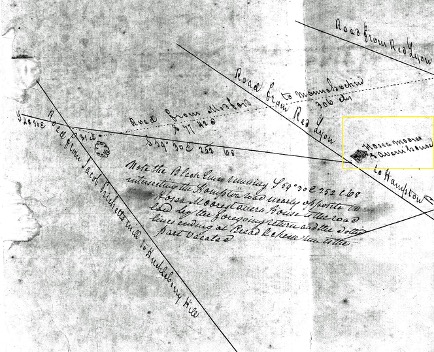
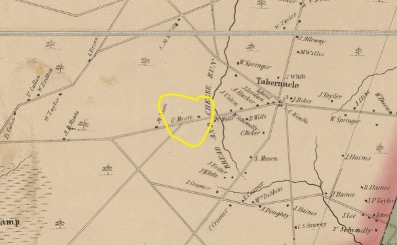
An 1824 road return (the creation of a new road) mentions Hosea’s tavern. The road was created as a route from Medford to Manahawkin. As we can see below it travels right to Hosea’s house. Today the road has several names as it continues to exist in many parts. It is Hawkin Road out of Medford and to the hotel site, then cuts across farmland as Fox Chase Road and “bumps in” to Friendship Mill. Then it becomes Powell Place Road and Sooy Place Road as it crosses Route 563 in Chatsworth. After this it moves to Route 72 where it parallels that state highway on the south side of the modern road.
As you look at the map below you can see some other familiar roads. The road from “Red Lion to Hampton” is Carranza Road. And the road from “Jacob Prickett’s Mill to Huckleberry Hill” is Pricketts Mill Road. You can also see that originally this road return proposed a more northerly route. Somewhat of an explanation for this is given on the map itself.
In 1832 father Hosea sold the 100 or so acres to his son Hosea for $4000.00. The Haines Old Mill Creek is again mentioned.

In his 1834 will, Hosea makes two significant bequeaths to his wife and to his child. Mary Moore receives “two rooms on the southeast side of the house, for her lifetime.” One is to be on each floor. And to son Aaron “the rest of the estate” as long as “he takes care of his mother.” He is also to “give two dollars a week to his mother,” as well as his married sister “Lydia Conrow.”
A circa 1840 map shows Hosea Moore’s tavern. You can also see the taverns of Alanson White and Josephus Sooy. The house of Eli Cramer is shown, and in this time frame it was known as the Tabernacle Hotel.

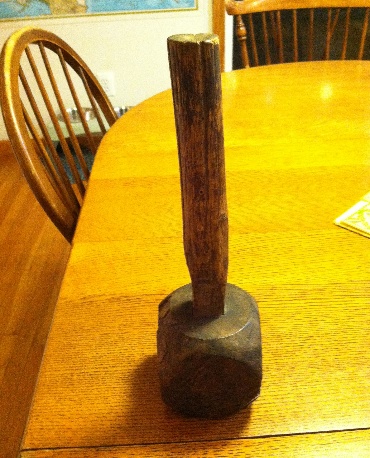
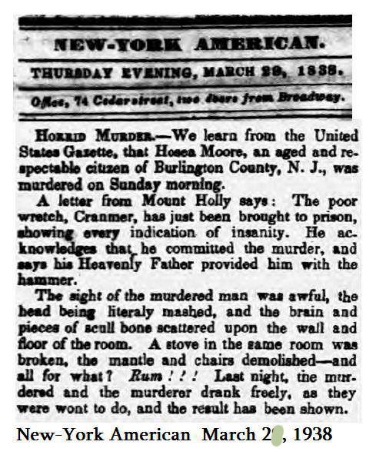
On the 23rd of March in 1838 Hosea Moore was murdered by his good friend Clayton Cramer (son of Eli Cramer). Apparently both men had been drinking heavily and gone to sleep in Hosea’s house. The next morning Clayton snuck into Hosea’s bedroom and smashed his head in with a wooden mallet. Some reports over the years have proposed that Hosea actually asked Clayton to murder him. It was said that Hosea was not of sound mind. He was buried in the Old Lumberton Cemetery, Lumberton, NJ. ( see https://tabernaclehistoricalsociety.org/ths-home-page/events/murder-and-mayhem/#moore ).
The actual murder weapon is believed to still exist and is in the possession of Moore’s descendants. Allegedly it was a bowling ball which had been “squared off” and made into a hammer. It has been shown to members of the Tabernacle Historical Society at a recent Society meeting.
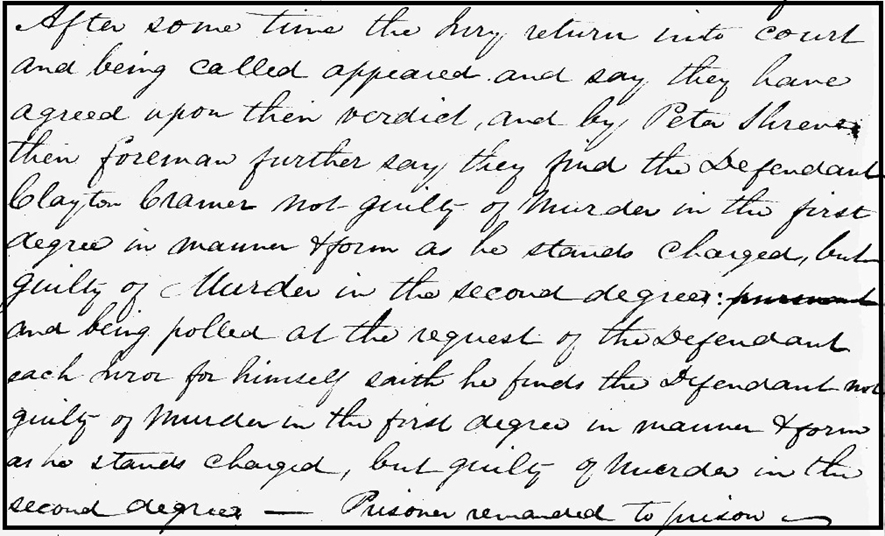
After a three-day trial before 12 jurors in a Mount Holly courtroom before the Oyers and Terminers Court, Clayton Cramer was found not guilty of 1st degree, but guilty of 2nd degree murder. He was sentenced to life in prison at hard labor.
In a somewhat related story, it was suggested that Hosea was responsible for the murder of Samuel Prickett (father of his brother-in-law John Prickett’s ). Allegedly, he had locked Samuel in a shed. Samuel was never again seen until his son John, several years later, found his father’s bones deep in the woods.
Census data is another source which can tell us much about a family. There are no censuses found before 1840 which show an Aaron B Moore. The census of 1840 lists our first person of that name. Undoubtedly it is the Aaron born in 1807, as his father Hosea was murdered in 1838, and he fits the age profile. The censuses show a person born in the 1810 and again in the 1820 who fits the age Aaron would be in those documents.
By 1850 Aaron is noted as a hotel owner whose property is valued at $40,000. In 1860 its value remains at forty grand and Aaron has eight children. In 1870 the land is assessed at $50,000, a nice increase over the preceding ten years. Aaron is now a master farmer with eleven children. He passes away in 1877 and of course does not appear in the next census. However, his wife Ascha and three sons do appear to be farmers. No value is given to their estate. In both the 1900 and 1910 censuses, Ascha appears with family nearby who are farmers. It is not totally clear if this is the property on today’s Carranza Road.
After his death, Hosea Moore deeds the land to his son Aaron Bishop Moore. Listed on the deed is the price of $9000. However, it is doubtful this was ever paid as Hosea did will the property to Aaron and Hosea had died a year earlier in 1838.
All tavern license applications have similar verbiage. The difference seems to be in the names of those signing the petition. Here is a complete version of an April 7, 1855, license application by Aaron B Moore:

To the judges of the court of Common Pleas, in the County of Burlington, April 10, 1855. The subscriber hereby requests the said judges to grant him a license to keep an inn and a tavern in the house wherein he now dwells in the Township of Southampton in the County of Burlington. Dated April 7, 1855. Aaron B Moore.
We the subscribers, Freeholders of the Township of Southampton in the County of Burlington; do hereby recommend Aaron B Moore to be licensed to keep an inn and a tavern, in the house wherein he now dwells, in said Township; and we do hereby certify that the said Aaron B Moore is of good repute for honesty and temperance, and is known to each of us to have at least two spare beds more than are necessary for the family’s use, and is well provided with house, room, ***ing and provender: And we do further certify that such tavern is necessary for the accommodations of stranger and traveler and for the transaction of public business and will conduct to the public good.
Dated April 7th, 1855”
The petition is signed by (their actual signatures)
Jervis Butterworth Benjamin Matlack
Noah Peacock Michael Bowker
Daniel Lukic William Gaskill
Japhet Woolston Charles Gaskill
H Kirkbride William Banford
Clayton Prickett Charles Austin
Isaac Prickett William ******

Aaron paid $10.00 for his license.
By 1869 the cost of a tavern license was $12.00. Aaron’s dwelling is mentioned as “Fox Chase.” The date of his petition is April 17th, 1869. It looks like a whole new set of “Freeholders” (with very poor penmanship) have signed the petition.
From 1870 through 1873 Aaron resides at the Fox Chase. The cost of his license is still $12.00. Many of the signers are the same.
New Jersey State Supreme Court case records from the early 1800’s are available at the State Archives. Unlike today, these records seem to deal with mostly debt, trespass and appeal of debt. If a trial is held, we are given the names of plaintiff, defendants, witnesses, jurors,” officials” and others participating in the case.
Hosea Moore was involved in several such cases. In one particular situation in August of 1803, (Case #887) he had issued a “writ of capias ad respondendum” (action requiring a sheriff to arrest and bring to court a certain person, so that a civil charge could be answered). The defendant was none other than Jacob Alloway, then owner of the Tabernacle Hotel.
The reason for the action is clearly spelled out in the Writ. Hosea Moore was owed $2528 by Jacob, and it seems Jacob was unable to pay the debt. Unfortunately, no disposition of the case is present in the record.
Before his murder in 1838, Hosea was involved in other Supreme Court cases. In five cases he was a defendant three times and a plaintiff twice.
And in 1819, he sat as a juror where a defendant was sued because he trespassed and built a new well and pump on another’s property.
The earliest known owner of this parcel of land was also no laggard when it came to court cases. William Fox had no less than eight contacts with the judicial system. As a plaintiff he had sued William Chambers over a debt ( 1783, Case #12686) and Edward Black over “trover and conversion” (1780, Case #12535).
Trover and conversion was a type of case in which the plaintiff seeks monetary value for his personal property which had been illegally used by another. Apparently Edward Black had used something of Fox’s and Fox did not want that item back, rather he preferred a cash settlement.
Fox was also a defendant in two cases. Edward Black had sued him for debt in 1782 (Case #2977), perhaps in relation to Fox’s earlier suit against him. Fox was also sued by one Sarah Dawson (1803, Case # 10098) for a dower issue. We only can guess the reason for this legal action!
And finally, William Fox was a juror in four cases. They involved trespass, an appeal of debt, deceit in altering a note and debt on bonds. It seems there was quite an active legal system in the late 18th century.
The type of State Supreme Court cases today is certainly far different than those of the early 20th century. And it is such a good thing. We can closely monitor the comings and goings of our forefathers and gain an intimate understanding of life in that time.
Aaron died in 1877. In his will his wife is to receive “all household goods she wants,” and $200 a year from his farm called “Quakerson.” Achsah Bozarth Moore is also to receive rights to pick cranberries at “Vinecomb Pasture” for “as long as she may live.” The rest of his estate goes to his twelve children except for Quakerson Farm. In a sly twist of legacy, Aaron wills that “If any of my children bring claims against my estate, then they get only five dollars.”
Vinecomb Pasture was land north of the Green Limb Branch of the Batsto River and somewhat south of today’s Chatsworth Road. It has been owned by the Moore family for over 150 years. Before that, we can find deeds dated in the late 1700’s and early 1800’s which show ownership by various Vinecomb family members.
Local lore states that the Vinecomb was an important place during the Revolutionary War. Cattle, horses, pigs and other farm animal were brought there from the towns nearby which had been subject to British marauders. The Brits were always confiscating American farm animals for food. Vinecomb was out of the way and saved many of the animals from British confiscation.
Fox Chase Farm in 1876:

By 1878 one of two lots was sold. Bread and Cheese Run is now mentioned as the waterway and reference is made to the “old mill pond,” possibly a reference to Friendship Mill.
In 1880 land was sold by Achsah Moore to William Irick. Again, the Bread and Cheese Run is mentioned.
And in 1907 Irick sells the land to the Burlington County Deposit and Trust Company for $5075.00. It’s noted as the same land Achsah Moore sold to William Irick in 1880.
Deeds in 1912 and in 1914 now refer to the land as the “Fox Chase Farm.” During this era the farm passed to the Tustin Family who later sold a good part of it to the local high school district.
In 1936 Charles Boyer hardly mentions the tavern:
On the road from Red Lion to Tabernacle, about three miles from the former place. It was opened about the end of the eighteenth century but, so far, the earliest proprietor known to have been there was William Fox. It was best known when Hosea Moore conducted it.
-Charles Boyer, 1936
And in 1955 Henry Bisbee notes the following about the site:
A hamlet on the road from Red Lion to the village of Tabernacle in northern part of township. Named for William Fox, who operated a Fox Chase Tavern here in the late eighteenth century. In 1838 timber was advertised for sale at Fox Chase. A continuation of the name was in effect when A. B. Moore named his farm Fox Chase.
-Henry Bisbee, 1955
In August of 1939, Nat Ewan provides us with a picture of the property.

On the reverse of the picture, Ewan writes the following:

The property after the fire in the 1950’s:
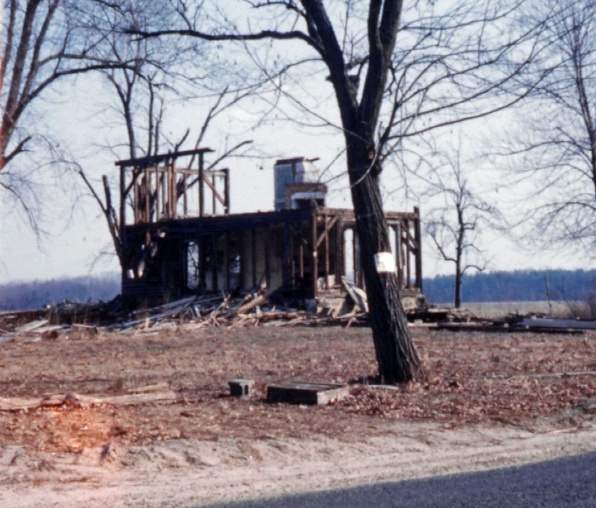
Today the property is the site of Seneca High School. Nothing left indicates the former presence of the Hotel. Once a historical society sign was located on the spot but was removed when tennis courts were built by the high school. The sign did say “a man was killed here in a bowling alley fight.” However, discussions with a 1950’s resident of the house stated there was nothing ever there which looked like a bowling alley. It is surmised that the story of the bowling ball hammer was somehow interpreted this way.
 Tabernacle Historical Society